25 LMS Demo Questions to Ask Before (and the Answers That Should Worry You)

A demo is the one hour in an LMS purchase when the vendor is on the back foot, and most buyers waste it. They watch a polished walkthrough, nod at the dashboards, ask about price at the end and leave with a good feeling and few facts. Knowing the right LMS demo questions to ask an LMS vendor changes that. It turns a sales presentation into an evidence-gathering session, and it exposes the gaps that only show up six months after you sign: reports that cannot answer a regulator’s question, learners who cannot log in without a company email, a contract that makes leaving expensive.
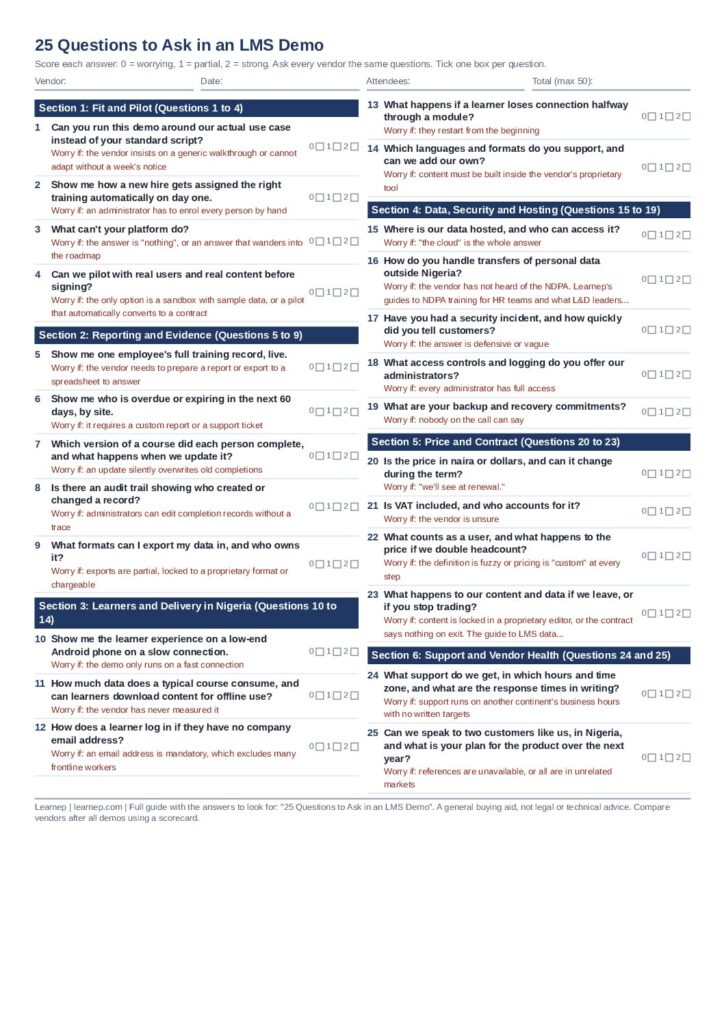
This guide gives you 25 questions grouped into six areas, with the answer you want to hear and the answer that should worry you. It is written for Nigerian buyers, so it covers local realities such as naira pricing, VAT, data hosting under the Nigeria Data Protection Act, mobile data costs and support hours, alongside the universal questions. It is meant to be used alongside the LMS vendor comparison scorecard, which helps you score vendors after the demo, and the broader checklist in choosing the right LMS for your business in Nigeria. A printable one-page version of the questions is available as a companion file.
For each question you will find two things: the answer you want to hear, and the answer that should make you pause. The pauses matter more than the polished answers. A vendor who gives a strong answer to ten questions and a vague one to the other fifteen has told you where the product ends and the sales process begins. Keep a simple score as you go, with 2 for a clear and specific answer, 1 for a partial one and 0 for a worrying or evasive one, and write down the exact words used on the questions that matter most to your organisation.
Memory is unreliable after a third demo, and a written record also makes it easier to compare vendors fairly, to brief colleagues who could not attend and to hold a vendor to what its team said when the contract arrives.
We encourage you to ask these questions of every vendor, including Learnep. A vendor that welcomes them is telling you something useful. A vendor that deflects is telling you something more useful still.
Why Do Software Buyers Regret Their Purchases?
Regret is the norm, not the exception, and most of it traces back to what was or was not asked before signing. A Capterra survey of 3,500 business software buyers in nine countries, published in February 2025, found that 57% of the UK businesses surveyed regretted at least one software purchase made in the previous 18 months. The survey’s authors noted differences in how successful and regretful buyers behaved.
Among successful buyers, 72% ran a product trial, against 51% of regretful buyers, and 72% started with a shortlist of one to four options, against 59% of regretful buyers. The reported consequences of poor purchases were increased costs (56%), reduced productivity (42%) and security vulnerabilities (35%). Capterra’s UK analyst David Jani put the lesson this way: “There’s a lot to learn from the 43% of UK companies that had successful software purchases.”
Those figures appear to come from the UK sample of a global survey, and they cover business software in general rather than LMS purchases specifically, so treat them as directional. They line up with what Learnep’s own guide on why LMS platforms fail argues: most failures are predictable, and a good demo is the cheapest place to predict them.
Section 1: Fit and Pilot (Questions 1 to 4)
1. “Can you run this demo around our actual use case instead of your standard script?” You want: a yes, with questions about your roles, sites and regulators. Worry if: the vendor insists on a generic walkthrough or cannot adapt without a week’s notice.
2. “Show me how a new hire gets assigned the right training automatically on day one.” You want: assignment by role, location or department without manual enrolment. Worry if: an administrator has to enrol every person by hand.
3. “What can’t your platform do?” You want: a direct, specific answer. Every platform has limits. Worry if: the answer is “nothing”, or an answer that wanders into the roadmap.
4. “Can we pilot with real users and real content before signing?” You want: a defined pilot with a start, an end and success criteria. Worry if: the only option is a sandbox with sample data, or a pilot that automatically converts to a contract.
Section 2: Reporting and Evidence (Questions 5 to 9)
5. “Show me one employee’s full training record, live.” You want: courses, dates, scores, versions and expiry on one screen, produced in seconds. Worry if: the vendor needs to prepare a report or export to a spreadsheet to answer.
6. “Show me who is overdue or expiring in the next 60 days, by site.” You want: a live view you can filter. Worry if: it requires a custom report or a support ticket.
7. “Which version of a course did each person complete, and what happens when we update it?” You want: version history attached to each completion, with a choice to retrain. Worry if: an update silently overwrites old completions.
8. “Is there an audit trail showing who created or changed a record?” You want: a log you can export. Worry if: administrators can edit completion records without a trace.
9. “What formats can I export my data in, and who owns it?” You want: standard formats such as CSV, and a clear statement that you own your data. Worry if: exports are partial, locked to a proprietary format or chargeable.
Section 3: Learners and Delivery in Nigeria (Questions 10 to 14)
10. “Show me the learner experience on a low-end Android phone on a slow connection.” You want: a live test on a cheap handset, not a laptop on office Wi-Fi. Worry if: the demo only runs on a fast connection.
11. “How much data does a typical course consume, and can learners download content for offline use?” You want: concrete numbers, compressed video and an offline option. See Learnep’s guides to low-bandwidth eLearning and mobile data costs for corporate training. Worry if: the vendor has never measured it.
12. “How does a learner log in if they have no company email address?” You want: phone-number or ID-based login. Worry if: an email address is mandatory, which excludes many frontline workers.
13. “What happens if a learner loses connection halfway through a module?” You want: progress saved and resumed automatically. Worry if: they restart from the beginning.
14. “Which languages and formats do you support, and can we add our own?” You want: clear answers on language, SCORM and other content formats, and on uploading your own material. The plain-English explanation of SCORM helps you judge the answer. Worry if: content must be built inside the vendor’s proprietary tool.
Section 4: Data, Security and Hosting (Questions 15 to 19)
15. “Where is our data hosted, and who can access it?” You want: a named location, named sub-processors and a clear access policy. Worry if: “the cloud” is the whole answer.
16. “How do you handle transfers of personal data outside Nigeria?” Under Section 43 of the Nigeria Data Protection Act, as explained in a May 2026 compliance guide by Adeola Oyinlade & Co., personal data cannot be transferred out of Nigeria unless the destination ensures an adequate level of protection, and where no adequacy decision exists, transfers generally rely on safeguards such as standard contractual clauses. You want: a signed data processing agreement and a stated transfer mechanism. Worry if: the vendor has not heard of the NDPA. Learnep’s guides to NDPA training for HR teams and what L&D leaders should know about the NDPC cover your obligations as the data controller.
17. “Have you had a security incident, and how quickly did you tell customers?” The point is not that incidents never happen. In April and May 2026, Instructure, the maker of the Canvas learning platform, suffered a breach that affected thousands of institutions. By Instructure’s own account the data involved included names, email addresses, student ID numbers and messages, and it found no evidence that passwords or financial information were taken. Unauthorised access began on 25 April, Instructure detected it on 29 April, disclosed it on 1 May, and on 11 May apologised for a lack of transparency.
The case concerns an education platform, not a corporate one, and some of the figures reported came from the attackers and were unverified, but it illustrates what to ask: detection time, disclosure time and what customers are told. You want: an incident history, a notification commitment in the contract and a named security contact. Worry if: the answer is defensive or vague.
18. “What access controls and logging do you offer our administrators?” You want: role-based admin permissions, single sign-on options and two-factor authentication. Worry if: every administrator has full access.
19. “What are your backup and recovery commitments?” You want: stated backup frequency, recovery time and a tested restore. Worry if: nobody on the call can say.
Section 5: Price and Contract (Questions 20 to 23)
20. “Is the price in naira or dollars, and can it change during the term?” You want: a written answer on currency, adjustment rules and caps. Learnep’s complete guide to LMS costs in Nigeria shows how much this single question can move your total. Worry if: “we’ll see at renewal.”
21. “Is VAT included, and who accounts for it?” You want: a clear answer. Foreign providers may charge VAT, and business customers may have to withhold it. Worry if: the vendor is unsure.
22. “What counts as a user, and what happens to the price if we double headcount?” You want: a precise definition (registered, active or concurrent) and a price schedule. Worry if: the definition is fuzzy or pricing is “custom” at every step.
23. “What happens to our content and data if we leave, or if you stop trading?” You want: a defined export in usable formats, a return-of-data clause and notice periods. The risk is real: when the corporate learning vendor Grovo shut down, its sunset FAQ told customers that “content produced using Grovo’s proprietary Create Tool cannot be downloaded.” User data could be downloaded through standard reports, but content built in the proprietary tool could only be kept within the successor’s system. Worry if: content is locked in a proprietary editor, or the contract says nothing on exit. The guide to LMS data migration explains what a clean move looks like.
Section 6: Support and Vendor Health (Questions 24 and 25)
24. “What support do we get, in which hours and time zone, and what are the response times in writing?” You want: support in West Africa Time, defined channels and response commitments in the contract. Worry if: support runs on another continent’s business hours with no written targets.
25. “Can we speak to two customers like us, in Nigeria, and what is your plan for the product over the next year?” You want: references of similar size and sector, and a roadmap with dates you can hold the vendor to. Worry if: references are unavailable, or all are in unrelated markets.
How Should You Run the Demo Itself?
Send your questions and a short brief ahead of time, including your roles, sites, regulators and the three reports you most need to see. Ask the vendor to demo your use case, not theirs. Bring one operational person, such as a training coordinator or site manager, because they will notice usability problems that a manager will not. Score each answer on a simple scale and compare vendors only after all demos are done, using the vendor comparison scorecard. Ask for a pilot before signing, since the survey above suggests that buyers who test the product regret less often.
If the vendor offers sample data only, ask them to load a small set of your own, such as ten fictitious employees across three roles, before the second demo. The speed and honesty of the response is itself a data point.
Common LMS Demo Questions Mistakes to Avoid
Letting the vendor control the agenda. If you only see what they chose to show, you will only learn what they chose to tell you.
Focusing on features instead of outcomes. A long feature list matters less than whether the three reports you need work well and quickly.
Leaving price and exit to the end. These are the questions with the most financial impact, and they should be asked early enough to compare.
Skipping the operational user. The person who will administer the platform every week should be in the room.
Ignoring local fit. A platform designed for office workers with fast broadband and company email addresses may fail a field workforce in Nigeria.
Treating the demo as the pilot. A demo shows the best case. A pilot with real users and content shows the real one.
Frequently Asked Questions
How many LMS vendors should we demo? Three to four is usually enough. The Capterra survey found that successful buyers more often began with a shortlist of one to four options, which suggests that a focused list beats a long one.
Who should attend an LMS demo? The person accountable for training, someone who will administer the system day to day, an operations or site representative, and someone from IT or data protection if personal data is involved.
Should we ask for a free trial or a paid pilot? Ask for a defined pilot with success criteria whichever way it is priced. In the Capterra survey, 72% of successful buyers ran a product trial, compared with 51% of regretful buyers.
What is the single most important question? If forced to choose one, ask the vendor to show you one employee’s complete training record, live. It tests reporting, data quality and usability in a single step.
Where This Fits in Your Buying Process
These questions are one step in a larger process. The guide to what an LMS costs in Nigeria and the explanation of total cost of ownership help you judge the price answers, and the 90-day implementation checklist covers what happens after you choose.
If you would like to test Learnep against these 25 questions, book a demo, send us your list in advance and bring your own sample data. You can also explore the Learnep features, read the FAQ page or check the pricing page.