
LMS for Mining and Solid Minerals Companies: Safety Training at Scale

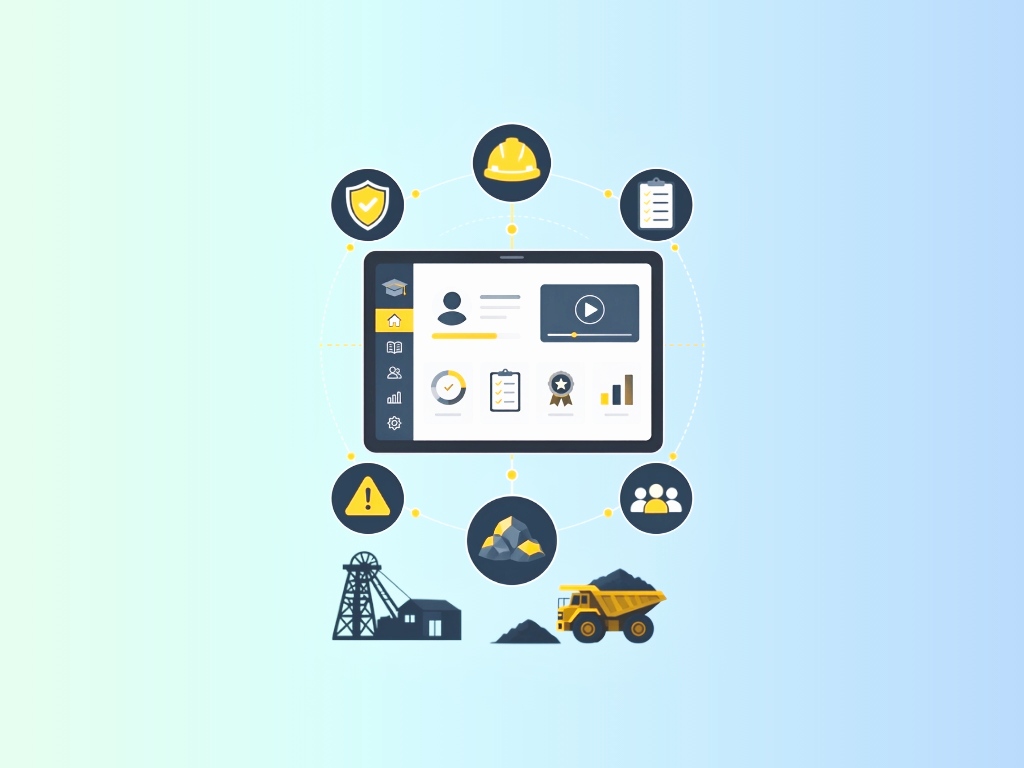
An LMS for mining and solid minerals companies in Nigeria has to deliver consistent, verifiable safety training to a workforce operating in some of the most remote, high-risk locations covered anywhere in this guide. Licensed operators like Dangote Cement, Lafarge Africa, and Segilola Resources Operating Limited, home to Thor Explorations’ Segilola gold mine in Osun State, run sites where heavy equipment, blasting operations, and physically demanding extraction work all carry real, immediate safety consequences, often at locations with little to no reliable grid power or connectivity.
The stakes behind rigorous, well-documented training in this sector go beyond any individual company’s internal safety culture. Nigeria’s mining industry operates alongside a large, largely informal artisanal mining sector, and that informal sector’s safety and environmental record is genuinely sobering, underscoring exactly why licensed, professionally regulated operators need to demonstrate rigorous, verifiable training standards, not just meet a minimum bar.
This guide covers the regulatory landscape licensed Nigerian mining companies train against, what makes mining safety training structurally different, and what an LMS built for this environment needs to deliver.
The Regulatory Landscape Mining Companies Train Against
The Nigerian Minerals and Mining Act 2007 is the core legislation governing the sector, explicitly prescribing measures for the protection and safety of workers in mining operations, alongside environmental safety obligations tied to every mineral title.
The Federal Ministry of Mines and Steel Development, sometimes referred to as the Ministry of Solid Minerals Development, handles policy formulation and overall sector regulation, while the Mining Cadastre Office (MCO) administers mining titles and licensing compliance. The Nigerian Geological Survey Agency (NGSA) provides the geoscientific data underpinning exploration and safety planning, and NESREA, alongside the Federal Ministry of Environment, enforces environmental compliance specific to mining operations.
The Employees’ Compensation Act 2010, administered through the Nigeria Social Insurance Trust Fund, governs workplace injury compensation, the same framework Learnep has covered in the context of manufacturing and construction.
The consequences of inadequate training and oversight in this sector aren’t abstract. A landmark public health crisis in Zamfara State, beginning in 2010, saw artisanal gold mining activity contaminate soil and water across several villages, resulting in the deaths of more than 400 children and lead poisoning affecting over 17,000 people, one of the most severe documented lead poisoning outbreaks anywhere in the world. A 2025 peer-reviewed study found airborne lead exposures at ongoing artisanal mining sites still running up to 30 times above permissible limits.
This crisis is specific to unregulated, informal artisanal and small-scale mining, distinct from licensed, formally regulated operations, but it illustrates exactly why the Minerals and Mining Act’s safety and environmental provisions exist, and why licensed operators have a genuine interest in maintaining demonstrably rigorous training standards that visibly set them apart from the informal sector’s record.
Why Mining Safety Training Is Structurally Different
Three features of this sector make a generic corporate LMS a poor fit without real adaptation.
Site locations are often extremely remote. Mining operations frequently sit far from reliable grid power or mobile network coverage, an even more extreme version of the connectivity challenge Learnep has covered in other field-based sectors, meaning training delivery has to function genuinely offline, not just on mobile devices.
Physical risk is high and equipment-specific. Blasting operations, heavy machinery, and confined space work each carry distinct, serious safety requirements, closely paralleling the equipment-specific certification challenges Learnep has covered in oil and gas and manufacturing.
Environmental compliance training sits alongside worker safety, not separate from it. Given NESREA’s direct oversight of mining’s environmental impact, training programs need to cover environmental protocols with the same rigor as physical safety, rather than treating environmental compliance as a separate department’s concern.
What Does an LMS for mining and solid minerals companies in Nigeria Need to Do?
At minimum, it needs to function reliably at genuinely remote, low-connectivity sites, track equipment and task-specific safety certification individually, integrate environmental compliance training alongside worker safety, and produce audit-ready documentation that demonstrates rigorous standards to regulators and stakeholders alike. Each of these breaks down further.
1. True offline capability for remote sites. Training needs to download fully and function without any active connection, syncing progress once a device reconnects, a baseline requirement given how many mining operations sit well outside reliable network coverage. Learnep’s guide to low-bandwidth eLearning in Nigeria covers this design constraint in more depth.
2. Equipment and task-specific certification tracking. The system should track certification for blasting operations, heavy equipment, and confined space work individually per worker, mirroring the equipment-specific rigor Learnep has covered in manufacturing and construction safety training.
3. Integrated environmental compliance training. Given NESREA’s direct oversight, environmental protocols should be tracked with the same certification rigor as physical safety training, not treated as a separate, lower-priority category.
4. Audit-ready documentation for regulatory and reputational purposes. Given the sector’s documented safety and environmental history at the informal level, licensed operators benefit from being able to demonstrate, on demand, exactly how rigorously their workforce is trained and certified.
Building a Mining Safety Training Program
Step 1: Map safety and environmental training requirements by role and task. Identify exactly which certifications apply to blasting, heavy equipment operation, confined space work, and environmental handling procedures specifically.
Step 2: Design for genuine offline delivery from the outset. Build training content assuming no reliable connectivity at the point of use, rather than retrofitting offline access onto a system designed for a connected environment.
Step 3: Track equipment-specific and environmental certification with equal rigor. Avoid treating environmental compliance as secondary to physical safety certification within the tracking system.
Step 4: Maintain a centralized, exportable safety and compliance record. Leadership should be able to confirm current certification status across every site without requesting updates individually from remote site managers.
Step 5: Review training content against incident data and evolving regulatory requirements. As mining regulation and environmental standards continue to develop, training content should be revisited on a fixed schedule rather than left static.
Illustrative scenario: Picture a licensed mining operator running a remote extraction site with limited connectivity. Rather than relying on paper-based safety records that site managers maintain independently, the company deploys an LMS with genuine offline functionality, allowing site staff to complete and log both safety and environmental training locally, with data syncing automatically whenever a connection becomes available. When a regulatory review or investor due diligence process requests training records, the company can produce a complete, current picture within minutes rather than requesting documents from a remote site team. This scenario illustrates a common pattern many licensed Nigerian mining operators are likely to encounter; it is not a documented Learnep case study.
Common Pitfalls to Avoid
Assuming any level of reliable connectivity at mining sites. Given how remote many operations are, a platform that depends on an active connection will consistently fail to reach the workforce that needs training most.
Treating environmental compliance training as a lower priority than physical safety. Both carry real regulatory consequences under NESREA and the Minerals and Mining Act, and both deserve equivalent tracking rigor.
Not tracking equipment-specific certification individually. A generic “safety trained” status obscures exactly which high-risk tasks a given worker is actually certified to perform.
Underestimating the reputational value of demonstrable training rigor. Given the informal sector’s well-documented safety and environmental record, licensed operators have a genuine business reason, not just a compliance one, to make their own training standards clearly and easily demonstrable.
Frequently Asked Questions
Does Nigerian mining law require worker safety training? Yes. The Nigerian Minerals and Mining Act 2007 prescribes measures for the protection and safety of workers as part of the conditions attached to mining titles, alongside environmental safety obligations enforced by NESREA and the Federal Ministry of Environment.
What’s the difference between artisanal and licensed mining regulation in Nigeria? Licensed operations hold formal mining titles from the Mining Cadastre Office and operate under the full regulatory framework of the Minerals and Mining Act, including its safety and environmental provisions. Artisanal and small-scale mining frequently operates informally, outside this regulatory structure, which has been directly linked to serious documented safety and public health consequences.
How can an LMS work effectively at extremely remote mining sites? By supporting genuine offline functionality, allowing training to be completed and logged locally with data syncing once connectivity becomes available, rather than requiring an active connection throughout the training session.
What environmental training obligations apply to mining companies in Nigeria? Mining operations fall under NESREA’s environmental compliance oversight and the Minerals and Mining Act’s own environmental safety provisions, meaning environmental protocol training should be tracked with the same rigor as physical worker safety training, not treated as a separate or lower-priority category.
Where This Fits Into a Broader Safety Strategy
Mining safety training sits at a genuine intersection of extreme site remoteness, equipment-specific physical risk, and environmental compliance obligations, layered against the backdrop of a sector whose informal segment carries a serious documented safety record. Learnep’s guide to LMS-based certification and credentialing covers the tracking mechanics relevant to equipment and environmental certification specifically, while our broader compliance training LMS guide covers the regulatory foundation shared across sectors.
You can also see how this fits alongside other high-risk, remote-workforce sectors on Learnep’s LMS solutions by industry page. If you’re responsible for safety and environmental training across a licensed Nigerian mining operation, explore how Learnep supports genuinely offline-capable training delivery, check the FAQ page, or book a personalised walkthrough to talk through your site’s specific connectivity and compliance needs.