LMS Implementation Checklist: A Practical 90-Day Rollout Plan


A solid LMS implementation checklist needs to do more than list tasks in order. It needs to prevent the specific failure pattern that derails most rollouts: teams execute every technical step correctly, migrate the data, configure the integrations, launch on schedule, and still end up with a platform nobody actually uses six months later. Industry research on LMS change management, drawing on G2’s 2025 Corporate LMS report, puts the average implementation timeline at 2.76 months, close enough to 90 days that it’s a realistic, well-tested planning window, and cites an industry average LMS adoption rate of just 71%, meaning nearly three in ten licensed users never meaningfully engage with the platform their organization paid for.
This guide sets out a practical, phase-by-phase checklist built around that 90-day window, covering planning, data migration, pilot testing, and full rollout, along with the specific points where implementations most commonly go wrong.
Why Most LMS Rollouts Underdeliver
Before the checklist itself, it’s worth understanding what typically causes it to fail in practice, because the pattern shows up across nearly every industry and platform.
Brandon Hall Group research has found that 44% of organizations are dissatisfied with their current LMS, and a disproportionate share of those organizations launched without a formal change management plan. The technical rollout succeeded. The organizational one didn’t.
One widely cited change management analysis captures the core mistake plainly:
the go-live date is not an outcome, it is a starting gun.
Organizations that pour effort into pre-launch planning and then quietly reduce attention once the system is live consistently see adoption decay, with logins peaking in the first week and dropping 40 to 60% by week six, rarely recovering to launch-week levels afterward.
That pattern is exactly why this checklist treats the 90 days as three connected phases rather than a single project with a single finish line.
The 90-Day Framework: Three Phases
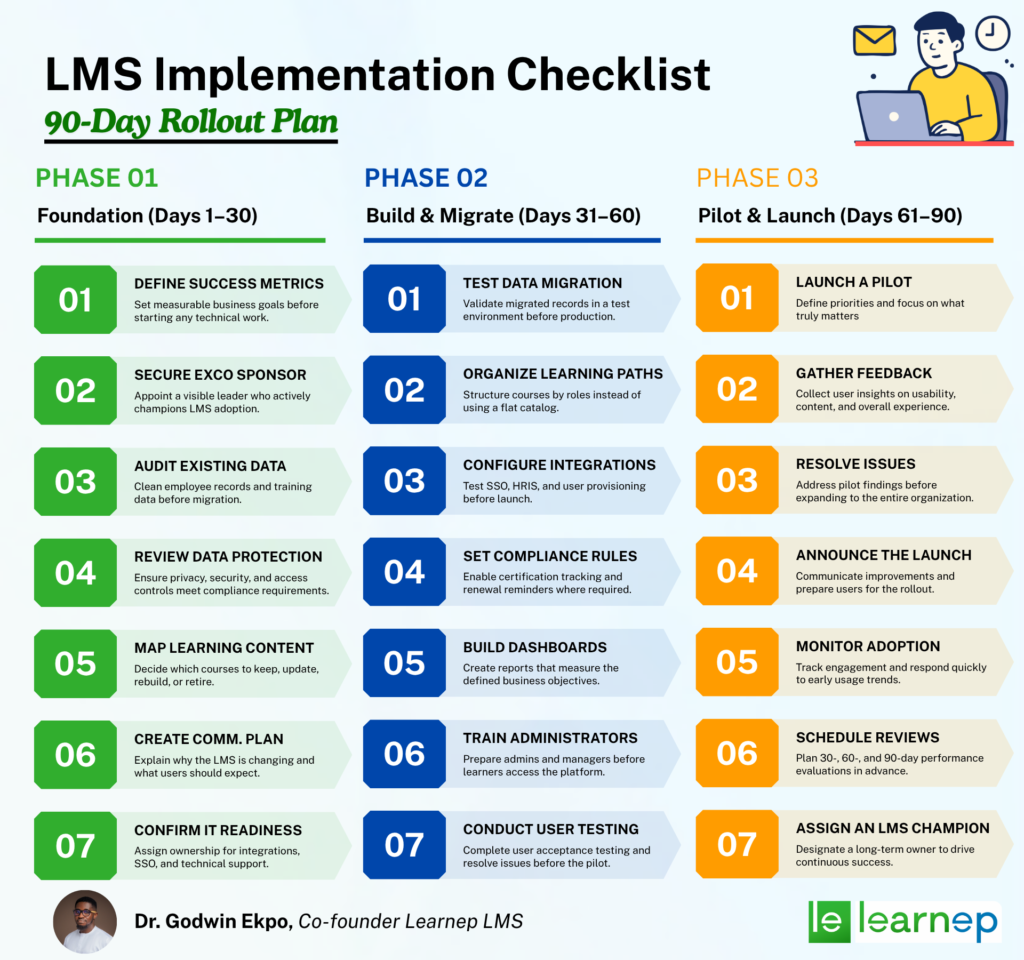
Phase 1, Days 1 to 30: Foundation. Define objectives, secure stakeholder buy-in, audit existing data and content, and design the structure the system will run on.
Phase 2, Days 31 to 60: Build and Migrate. Execute data migration, build or upload course content, configure integrations and role-based access, and run internal testing before anyone outside the project team sees the system.
Phase 3, Days 61 to 90: Pilot and Launch. Roll out to a smaller pilot group first, gather and act on feedback, then move to full organization-wide launch with a defined post-launch review built into the plan from day one.
What Should Be in an LMS Implementation Checklist?
A complete checklist covers five categories at minimum: clear success metrics, a full data and content audit, technical configuration and integration testing, a structured pilot before full rollout, and a scheduled post-launch review. Each of these breaks down into specific, actionable tasks.
Phase 1 Checklist: Foundation (Days 1 to 30)
- Define 3 to 5 measurable success outcomes before any technical work begins (for example, reduced onboarding time, improved compliance completion rates, or fewer repeat safety incidents), not just a go-live date.
- Secure a visible executive sponsor who will use the system themselves and talk about it publicly, not just approve the budget.
- Audit existing training records and employee data for accuracy before migration, rather than migrating errors into the new system.
- Review data protection and access requirements, including NDPA-relevant safeguards for any personal data the platform will hold.
- Map course content to roles and departments, identifying what needs to be rebuilt, converted, or retired rather than migrated as-is.
- Draft a communication plan explaining why the organization is changing systems, not just how to log in.
- Confirm IT resourcing, including who owns single sign-on (SSO) configuration and integration with existing HR systems.
Phase 2 Checklist: Build and Migrate (Days 31 to 60)
- Execute data migration in a test environment first, and verify record accuracy before touching production data.
- Build or upload courses mapped to the role-based structure defined in Phase 1, rather than a single flat catalogue.
- Configure SSO and HRIS integrations, and test bulk user provisioning at realistic scale before cutover, since authentication issues often surface only when large batches of accounts are created simultaneously.
- Set up compliance and certification tracking rules, including expiry alerts, if the organization has regulatory training obligations.
- Build reporting dashboards mapped to the success metrics defined in Phase 1, not generic completion percentages alone.
- Train administrators and managers on the system before any learner sees it, since manager engagement strongly predicts learner adoption.
- Run structured user acceptance testing (UAT) with a small internal group and fix issues before the pilot phase begins.
Phase 3 Checklist: Pilot and Launch (Days 61 to 90)
- Launch to a pilot group first, ideally one representative department or site rather than the whole organization at once.
- Collect structured feedback from the pilot group on both usability and content relevance, not just technical bugs.
- Fix identified issues before expanding to full rollout, rather than treating pilot feedback as optional polish.
- Communicate the full launch clearly across the organization, including what changed based on pilot feedback.
- Track adoption metrics from week one, expecting and planning for the typical early login peak and subsequent dip.
- Schedule 30, 60, and 90-day post-launch reviews in the project plan before go-live, not as an afterthought once usage numbers disappoint.
- Assign an ongoing LMS champion as a permanent role, not a temporary project assignment that ends at launch.
A Readiness Scorecard Before You Start
Before beginning the 90-day clock, it helps to score organizational readiness honestly across five areas: confirmed executive sponsorship, a realistic budget covering both implementation and post-launch support, a completed data and content audit, allocated IT resourcing, and a communication plan already drafted. An organization that’s weak in two or more of these areas should address them before starting the formal rollout, since starting the clock on an unready foundation tends to compress the phases that matter most rather than genuinely accelerating the timeline.
Illustrative scenario: Picture a retail chain rolling out an LMS across warehouse and store locations in Nigeria, where a large share of frontline staff don’t have individual company email addresses. A rollout plan built around email-based logins alone would exclude much of that workforce from day one. Building the checklist around phone-number-based access and offline-capable mobile delivery from the Phase 1 planning stage, rather than discovering the gap during Phase 3 testing, is what determines whether frontline staff are actually reached. This scenario illustrates a common pattern many distributed Nigerian employers face; it is not a documented Learnep case study. Learnep’s guide to low-bandwidth eLearning in Nigeria covers this design constraint in more depth.
Common Pitfalls to Avoid
Treating go-live as the finish line. As covered above, post-launch attention needs roughly the same investment as pre-launch planning, not a fraction of it.
Skipping the data audit before migration. Migrating inaccurate or outdated employee and training records simply moves the same problems into the new system.
No defined success metrics before technical work starts. Without 3 to 5 measurable outcomes agreed in advance, teams can complete every checklist item and still have no way to judge whether the rollout actually worked.
Rolling out to everyone at once. A pilot phase catches usability and content problems while the stakes are still low, before they affect the entire organization’s first impression of the system.
Underestimating resistance to change. Research on why change programs fail attributes roughly 39% of failures to employee resistance and another 33% to insufficient leadership support, closely tied to how visibly leadership models using the new platform themselves.
Read more: 10 Common Pitfalls of Learning Management System Implementation in Nigerian Organizations
Frequently Asked Questions
How long does LMS implementation typically take? Industry data puts the average around 2.76 months, close to the 90-day window this checklist is built around. Straightforward deployments with minimal integrations can move faster, while implementations involving multiple systems, large-scale data migration, or complex regulatory requirements often take longer.
Should you pilot with one department first, or launch to everyone at once? A pilot with one representative department or site is generally the safer approach. It surfaces usability and content issues while the audience is small, and gives the project team a chance to fix problems before the full organization forms its first impression of the system.
What’s the biggest risk during LMS data migration? Migrating inaccurate records is the most common and most preventable risk. Auditing existing data before migration, rather than assuming it’s clean, catches errors while they’re still cheap to fix.
What happens after the 90 days are up? The rollout isn’t finished at day 90, even though the formal project plan often is. Ongoing adoption tracking, a permanent LMS champion role, and scheduled reviews beyond the initial 30/60/90-day checkpoints are what prevent the login-peak-then-decline pattern common to unmonitored rollouts.
Where This Fits Into a Broader LMS Strategy
An implementation checklist is only as useful as the planning that precedes it and the attention that follows it. Learnep’s broader guide to how an LMS works for Nigerian companies is a useful starting point if you’re still evaluating whether and how an LMS fits your organization before committing to a rollout timeline. Once implementation is underway, guides like Learnep’s work on certification and credentialing and compliance training requirements can help shape what gets built during Phase 2 specifically.
Getting the technical rollout right is necessary but not sufficient. The organizations that see real returns on an LMS investment are the ones that treat the 90 days as the beginning of an ongoing adoption effort, not the entire project.