Why Cohort-Based Learning and Mentorship Are Reshaping Employee Development in Nigerian Organisations

Traditional corporate training programs are failing the modern workforce. As demand for cohort Based learning and mentorship in Nigeria continues to grow, many organizations are realizing that conventional training methods no longer deliver the engagement, accountability, and workplace performance improvements modern employees need.
For years, human resource managers across the country relied on a predictable formula: buying expensive, pre-recorded video courses or packing employees into a physical hotel conference room in Ikeja or Abuja for a two-day marathon seminar.
The results were almost always the same. Logoff rates spiked, engagement plummeted, and the actual transfer of knowledge back to the office floor was minimal. Isolated digital modules feel like digital punishments. Employees click through slides while muted, answering emails in another browser tab, waiting only for the certificate of completion. This disconnected framework cannot solve complex execution problems.
To build resilient teams, progressive leaders are completely reimagining corporate learning and development Nigeria. The modern operational environment demands collective agility, deep contextual knowledge, and immediate application.
This shifting reality explains the explosive rise of Cohort-Based Learning and Mentorship in Nigerian Organisations as the premier strategy for sustainable workforce growth. By blending community accountability with structured professional guidance, this dual approach turns passive knowledge consumption into an active, collaborative business driver.
The Relatable Reality: Moving Beyond the Isolated Inbox
Consider the experience of Tunde, a newly promoted microfinance operations manager in a rapidly growing financial institution with branches in Yaba, Ibadan, and Akure. After his promotion, HR assigned him twelve hours of self-paced leadership videos on a generic global platform. He was expected to watch these modules between daily operations, loan reconciliations, and constant fire-fighting.
Tunde tried his best. He logged in late at night, battled fluctuating internet connectivity, and stared at a screen listening to a generic foreign instructor discuss management frameworks designed for Silicon Valley startups. There was no one to ask how these models applied to a credit officer dealing with default realities in a local market open-air space. There was no colleague to debate with, and no mentor to guide his local execution. After three weeks, Tunde abandoned the modules entirely. His story is not unique. It plays out across thousands of entry-level and mid-management tiers nationwide every single week.
The alternative model is completely different. Imagine if Tunde had been placed into a focused group of fifteen peers from different regional branches, moving through a structured six-week transformation track together. Every Tuesday, they meet online to solve real-world operational challenges. Every Thursday, a senior executive from their industry reviews their case studies via interactive feedback sessions. This structured group environment creates an entirely different outcome. This is the framework changing the landscape of corporate upskilling.
Understanding the New Paradigm: The QDCA Engine
What is Cohort-Based Learning and Mentorship in Nigerian Organisations and why is it growing?
Definition: It is an interactive, community-driven education strategy where a specific group of employees advances through a learning curriculum together, actively supported by senior professional guides.
Context: Corporate teams from Lagos fintech hubs to legacy energy companies in Port Harcourt use this approach to combat low completion rates and bridge deep technical execution gaps.
Answer: Cohort-Based Learning and Mentorship in Nigerian Organisations combines structured, time-bound group progress with local institutional wisdom. Instead of learning in isolation, employees solve real corporate problems collectively, backed by contextual advisory support. This powerful mix replaces passive video watching with active peer accountability and practical skill application.
Driving Factors: Why Cohort-Based Learning and Mentorship Matters Across Nigerian Organisations
The shift toward collaborative development frameworks is driven by severe economic and operational realities. Modern organisations cannot afford to waste capital on ineffective training methodologies.
Bridging the Workforce Readiness Mismatch
The primary structural challenge facing corporate leaders is the widening skill gap. A comprehensive study by the Chartered Institute of Personnel Management (CIPM) Nigeria revealed that over 70% of corporate HR executives believe formal educational institutions do not sufficiently prepare graduates for contemporary operational roles. Consequently, internal talent development Nigeria initiatives must do the heavy lifting of building technical and soft competencies from scratch.
Isolated learning fails here because raw graduates need more than information; they need behavioural modification and professional socialization. Group learning tracks provide a protective sandbox environment where junior professionals can learn the cultural norms, communication nuances, and execution standards of their specific industry alongside their peers.
Mitigating High Talent Turnover Realities
The continuous migration of mid-level professionals to international markets, widely known locally as the Japa phenomenon has hollowed out the critical middle-management layer in many institutions. Organisations are forced to fast-track junior executives into complex leadership positions far earlier than anticipated.
| The Mid-Level Leadership Dilemma | |
| Trigger | Accelerated attrition (Japa) empties the middle-management layer |
| Traditional response | Isolated, generic self-paced videos |
| Result | Low retention, high execution failures |
| Modern strategy | Cohorts paired with internal mentors |
| Result | Rapid knowledge transfer, organisational stability |
Placing a junior officer in front of a self-paced video track does not prepare them to manage a team or navigate complex internal politics. They need seasoned guidance. Integrating intentional mentorship into your group training tracks ensures that institutional knowledge is preserved and transferred directly to the rising generation of leaders.
Overcoming Infrastructure and High Data Constraints
We must design corporate learning for the actual environments our teams work in. High mobile data costs, erratic power supplies, and long commute times in cities like Lagos mean that expecting workers to spend hours streaming unoptimized video content at home is unrealistic.
Group learning models address this limitation perfectly by condensing training into highly structured, high-value synchronized sessions. Instead of demanding endless hours of independent online streaming, the model relies on shorter, highly impactful group discussions, shared project assignments, and structured peer reviews that can be completed efficiently during designated office hours.
Mechanics of Implementation: A Step-by-Step Execution Guide for Cohort-Based Learning and Mentorship
Transitioning your team to an collaborative development model requires deliberate planning and structural design. It is not as simple as placing employees into a WhatsApp group chat and hoping for the best. You must approach it with a clear, systematic framework to build a sustainable learning culture in your organisation.
Step 1: Diagnose the Execution Gap via Targeted Audits
Before designing a single module, identify the exact operational blockages within your departments. Avoid generic topics like “Improving Workplace Communications.” Instead, zero in on quantifiable issues, such as reducing client onboarding errors in your customer success tier or improving code documentation practices within your engineering division.
Step 2: Assemble Diverse, Multi-Disciplinary Cohorts
Break down departmental silos by grouping individuals from different functional areas who share a similar seniority level. A cohort of fifteen professionals containing team members from compliance, sales, and operations yields far richer project outcomes than a group composed entirely of account officers. This internal diversity builds structural empathy across your company.
Step 3: Formalize Context-Driven Advisory Tracks
Select senior internal stakeholders or external domain experts to serve as dedicated programmatic mentors. These advisors should not deliver long, boring lectures. Their primary function is to facilitate weekly case-study reviews, challenge assumptions, and provide real-world critique on the active projects your groups are completing.
Step 4: Embed Active Problem-Solving Projects
Design the entire curriculum around a central, high-impact business problem. If your group is studying agile project management, their capstone assignment should be creating a fully functional launch strategy for a new company product. The goal is simple: the final project output should be immediately useful to your executive leadership team.
Step 5: Establish Continuous Feedback Loops
Implement a structured evaluation framework that goes beyond simple end-of-course questionnaires. Utilize peer-evaluations, advisor feedback assessments, and operational KPIs to measure how successfully learning translates into actual workplace productivity.
The Core Operational Limitation: Acknowledging the Boundaries
While highly effective, implementing this strategy requires significant internal resources. It demands a level of organizational commitment that self-paced e-learning platforms simply do not require.
- Senior executives must give up real hours from an already full calendar. If your leadership team is buried in operational crises, the mentoring layer collapses first not last.
- Cohort programmes scale more slowly than automated, self-paced platforms. Running five high-quality cohorts at once takes more coordination than assigning five thousand people the same video module.
- Quality depends heavily on mentor selection. A poor mentor match can do more damage to morale than no mentorship at all, since employees notice quickly when a senior “guide” is just phoning it in.
- Measuring soft outcomes — confidence, judgment, cross-functional empathy takes longer than measuring a completion percentage, which can make the early months look slower than they actually are.
None of this is a reason to avoid the model. It is a reason to set realistic milestones, staff the programme properly, and resist the temptation to launch five cohorts in month one when two, run well, would prove the concept far more convincingly.
Real World Application: The Lagos Consumer Finance Success Story
To understand the practical power of this methodology, consider the transformation of a prominent consumer finance institution headquartered in Victoria Island, Lagos. Managing a distributed workforce of over four hundred loan officers across twenty-two states, the company faced a massive drop-off in regulatory compliance training completion rates.
Their automated compliance modules had a dismal 14% completion metric, leading to costly documentation errors and regulatory fines.
| Case Study Transformation Metrics | ||
| Metric | Old Video Model | Learnep Cohort Model |
| Programme Completion Rate | 14% | 89% |
| Onboarding Review Time | 24 days | 9 days |
| Regulatory Fine Incidents | Frequent | Zero |
The human resource management team completely overhauled their approach. They grouped their distributed loan officers into distinct regional cohorts of twenty, running parallel six-week learning sprints on a dedicated social learning platform.
Every cohort was assigned an internal regional compliance auditor as a dedicated guide. Instead of reading boring PDF manuals in isolation, the groups worked together every Friday afternoon to dissect real, anonymized compliance failure cases from the previous month.
The outcomes were immediate and measurable. Within two quarters, program completion rates surged to 89%. More importantly, the average time required to process and approve loan documentation dropped from twenty-four days to just nine days, while regulatory non-compliance incidents dropped to zero. The institution did not hire more compliance staff; they simply unlocked the collective intelligence of their existing team.
How Learnep Solves This for Your Organisation
Building and managing interactive learning groups without the proper digital infrastructure can quickly turn into an administrative nightmare. Using disconnected tools like scattered emails, unorganized WhatsApp groups, and generic video conferencing links leads to fragmented tracking, lost assignments, and low engagement.
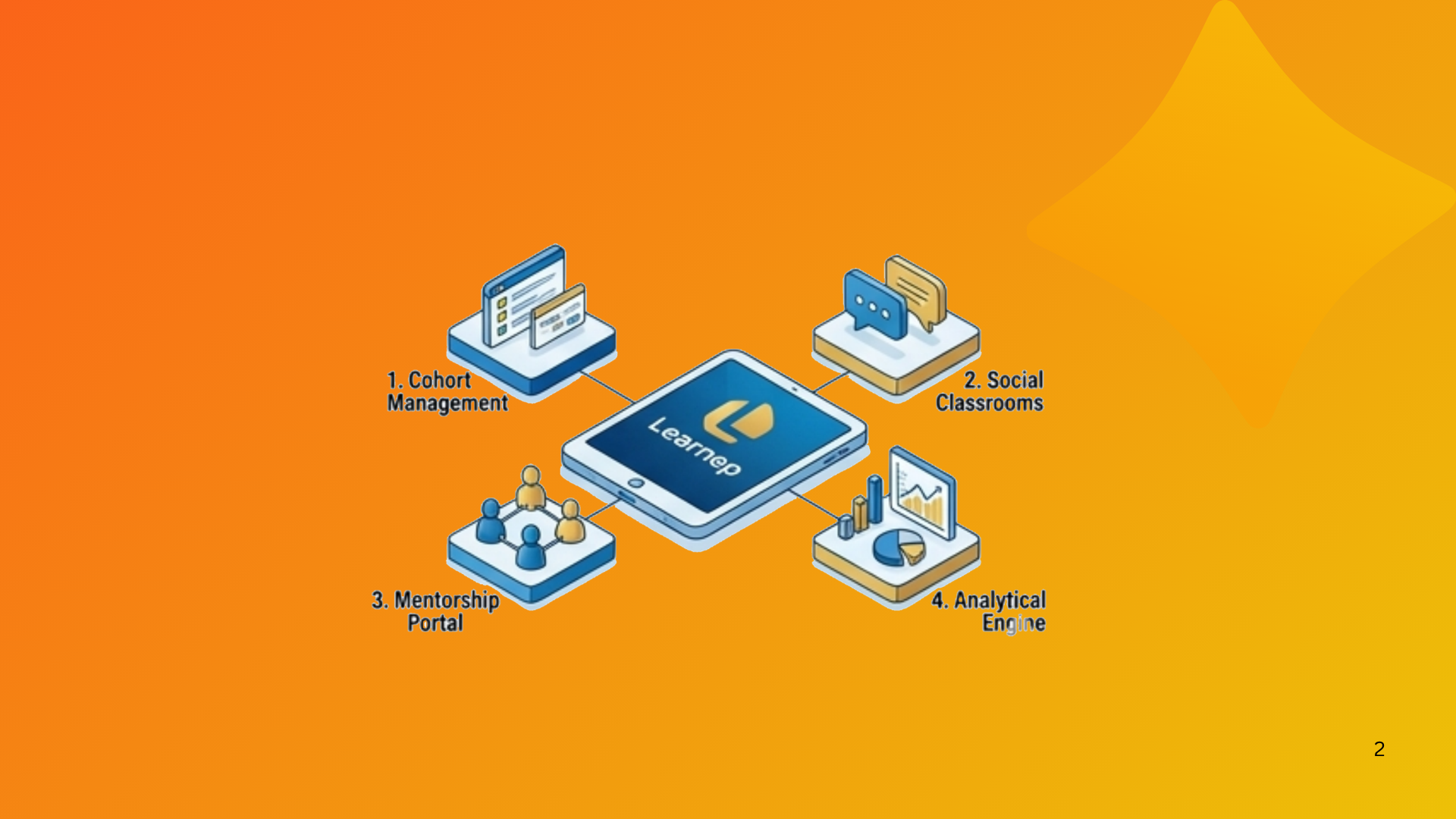
Learnep was built specifically to eliminate these operational headaches. Our enterprise platform provides a unified, all-in-one digital environment designed specifically for modern African businesses.
| The Learnep Architecture | |
| Cohort Management | Auto-allocates teams and coordinates timelines |
| Social Classrooms | Centralises peer reviews and group debates |
| Mentorship Portal | Connects senior guides with active projects |
| Analytical Engine | Tracks real-time engagement and growth |
Our specialized platform architecture features interactive social learning spaces where teams can collaborate on real business projects, exchange feedback, and debate corporate solutions right alongside their learning modules. The dedicated mentoring interface allows your senior executives to review capstone projects, host office hours, and provide targeted feedback without drowning in administrative micro-management.
With real-time engagement analytics, your L&D leaders gain absolute visibility into group dynamics, peer participation, and skill acquisition metrics. Learnep transforms workplace training from an isolated check-the-box activity into a vibrant, collaborative engine for business growth.
Frequently Asked Questions
What is the ideal size for a learning cohort in a Nigerian company?
The sweet spot for active group engagement is between twelve and twenty participants. Groups smaller than twelve often struggle to maintain lively, diverse discussions when operational workloads get heavy. Conversely, groups larger than twenty quickly become unmanageable, making it easy for quieter employees to hide behind more vocal peers.
How much does it cost to deploy cohort-based learning compared to physical training?
While custom digital cohort programs require an initial investment in platform infrastructure and curriculum design, they are far more cost-effective than traditional physical training seminars. By eliminating expensive hotel venue rentals, flight logistics for regional teams, and lost productivity from taking staff out of office, digital groups cut overall training costs by up to 60%.
How does cohort learning differ from a standard WhatsApp training group?
A WhatsApp group is a linear chat feed that lacks structured curriculum progression, centralized assignment tracking, or robust data privacy controls. In contrast, true cohort learning uses a dedicated platform like Learnep to integrate organized modules, document repositories, peer-review frameworks, and detailed analytics into one secure ecosystem.
How do we motivate busy senior managers to act as internal mentors?
Align your mentorship initiatives directly with your organization’s succession planning and leadership KPIs. When senior executives see that guiding these groups is explicitly recognized as part of their own performance evaluations, and that it helps build high-performing talent for their own departments, buy-in increases dramatically.
What are the biggest execution challenges when running digital cohorts?
The primary operational hurdles are maintaining consistent engagement when daily workloads spike and navigating local internet connectivity issues. These challenges are easily mitigated by building flexible asynchronous windows into your weekly deadlines and using mobile-optimized, low-bandwidth platforms like Learnep to keep learning seamless.
Driving Continuous Transformation: The Future of Cohort-Based Learning and Mentorship in Nigerian Organisations
True organizational growth is never an accidental occurrence. It is the direct result of deliberate systems designed to foster continuous improvement. Relying on outdated, isolated training models leaves your workforce underprepared for today’s fast-changing market realities.
Implementing structured group learning paths and contextual internal guidance creates a highly resilient system for rapid knowledge transfer. This approach ensures your team solves real business challenges collectively, turning workplace learning into your ultimate competitive advantage. Protect your company’s future by building an environment where your people grow together.
“No employee grows alone in a vacuum, and no organisation grows by training one person at a time. Cohort-Based Learning and Mentorship in Nigerian Organisations works because it puts people back at the centre of progress, learning beside each other, accountable to each other, building something none of them could have built alone.”