
Elevating L&D Beyond a Cost Centre in Nigerian Organizations


Many Nigerian organizations still perceive Learning and Development (L&D) as a cost centre, treating it as an expense rather than a strategic investment. For many organizations in Nigeria and beyond, this post on elevating L&D beyond a cost centre is a necessity in today’s business environment.
This outdated mindset limits growth, weakens workforce capability, and reduces organizational competitiveness. In contrast, forward-thinking organizations now recognize that L&D is a critical driver of performance, innovation, and long-term success.
To remain relevant in an increasingly digital and competitive economy, Nigerian organizations must shift from viewing L&D as a cost burden to embracing it as a value-generating function.
What is Learning and Development (L&D)
Learning and Development (L&D) refers to a structured approach to improving employee performance through the continuous acquisition of knowledge, skills, and competencies.
Its core objective is to enhance both individual capability and organizational effectiveness.
L&D initiatives typically include:
- Workshops and seminars
- Online and e-learning courses
- Coaching and mentoring programs
- On-the-job training
- Leadership development programs
When implemented effectively, L&D becomes a strategic tool that drives productivity, innovation, and long-term business success.
The Strategic Importance of L&D in Nigerian Organizations
L&D plays a critical role in strengthening workforce capability, improving productivity, and closing persistent skills gaps within Nigerian organizations. As industries continue to evolve rapidly—driven by technological advancements, digital transformation, and shifting market demands—the need for continuous employee development has become more urgent than ever.
By investing in L&D, organizations can equip their workforce with relevant, future-ready skills, enabling them to adapt, innovate, and remain competitive in an increasingly dynamic business environment.
1. Bridging Critical Skills Gaps
Nigeria faces a significant skills mismatch in its workforce, particularly in digital, technical, and soft skills.
- Many employees lack industry-relevant competencies
- Rapid technological changes continue to widen this gap
- L&D helps bridge these deficiencies through targeted training
By fostering a culture of continuous learning, organizations can remain relevant and future-ready.
2. Enhancing Workforce Productivity
L&D aligns employee development with business objectives, resulting in:
- Improved job performance
- Higher efficiency
- Increased engagement
Employees who feel invested in are more motivated and committed, leading to higher productivity levels.
3. Driving Organizational Competitiveness
In today’s fast-changing business landscape:
- Organizations must adapt quickly to new technologies and trends
- A well-trained workforce enables faster innovation and decision-making
Companies that prioritize L&D gain a competitive advantage by building agile and capable teams.
4. Supporting Career Growth and Employee Satisfaction
Employees value organizations that invest in their development.
L&D:
- Enhances career progression
- Builds confidence and competence
- Increases job satisfaction
This leads to stronger employee loyalty and retention.
5. Ensuring Long-Term Business Sustainability
Organizations that invest in continuous learning are better positioned to:
- Adapt better to change
- Retain top talent
- Maintain consistent growth
Key Challenges Facing L&D in Nigerian Organizations
Despite the growing need for elevating L&D beyond a cost centre in Nigerian Organizations, many organizations still face several structural and operational challenges that limit the effectiveness of their L&D initiatives.
These challenges—ranging from limited budgets and low employee engagement to poor measurement of training outcomes—continue to reinforce the perception of L&D as a cost centre rather than a strategic investment. Additionally, factors such as lack of leadership support, time constraints, and irrelevant training content further weaken the impact of learning programs.
1. Lack of Time for Learning
One of the most common challenges is the difficulty employees face in balancing work responsibilities with learning activities. Training sessions are often scheduled during working hours, yet workloads remain unchanged.
As a result, employees struggle to focus fully on training while thinking about pending tasks and deadlines. This divided attention reduces learning effectiveness and limits knowledge retention.
2. Low Engagement in Training Programs
Many training programs rely heavily on traditional teaching methods such as long presentations and lecture-style delivery. These approaches often fail to actively involve participants.
Without interaction, practical application, or engagement, employees may attend training sessions physically but gain little real value from them.
3. Disconnect Between Training and Job Roles
Training programs that are too generic or theoretical often fail to address the specific needs of employees in their roles.
When employees cannot clearly see how training applies to their daily responsibilities, they lose interest. Effective L&D must be tailored to solve real workplace challenges.
4. Limited Budget Allocation
Financial constraints remain a major barrier, especially for small and medium-sized enterprises (SMEs) in Nigeria.
Since L&D is often viewed as a non-essential expense, it becomes one of the first areas to face budget cuts. This leads to poorly designed programs, lack of resources, and reduced training frequency.
5. Resistance to Learning and Change
Introducing new skills, tools, or systems can create discomfort among employees, particularly when it disrupts familiar routines.
This resistance is often driven by fear of failure, uncertainty, or lack of confidence. Without proper support and communication, employees may resist learning initiatives.
6. Lack of Leadership and Managerial Support
The success of L&D programs largely depends on the attitude of leadership.
When managers do not actively support or prioritize training, employees perceive it as unimportant. In contrast, strong leadership involvement encourages participation and application of new skills.
7. Difficulty in Measuring Training Effectiveness
Many organizations struggle to evaluate whether their training programs are delivering real value.
Without clear metrics—such as performance improvement, productivity gains, or return on investment (ROI)—it becomes difficult to justify continued investment in L&D.
8. One-Size-Fits-All Training Approach
Employees have different learning styles, experience levels, and job requirements. However, many organizations apply a uniform training approach for all staff.
This lack of personalization reduces the relevance and effectiveness of training programs, making them less impactful.
Understanding Why L&D is still treated as a Cost Centre in Nigerian Organizations
Despite its proven benefits, Learning and Development (L&D) is still widely perceived as a cost centre in many Nigerian organizations. This perception is shaped by several underlying factors that limit how organizations view and implement employee development initiatives.
- Lack of Awareness: Many leaders do not fully understand its long-term value, so it is treated as optional.
- Short-Term Focus: Organizations prioritize quick profits, while L&D delivers results over time.
- Poor Measurable outcome: Without clear data showing impact, training appears ineffective.
- Limited Budget: When funds are tight, L&D is one of the first areas to be cut.
- Fear of Turnover: Employers worry that trained employees may leave.
- Weak Leadership Support: Without management involvement, L&D is not taken seriously.
Transforming L&D from a Cost Centre into a Strategic Value Driver in Nigerian Organizations
Transforming L&D into a strategic value driver means repositioning it from a routine training function into a core business strategy that directly supports organizational growth and performance.
In this approach, L&D is no longer treated as an isolated activity or cost centre. Instead, it is intentionally aligned with business objectives such as improving productivity, closing critical skills gaps, increasing employee performance, and driving innovation.
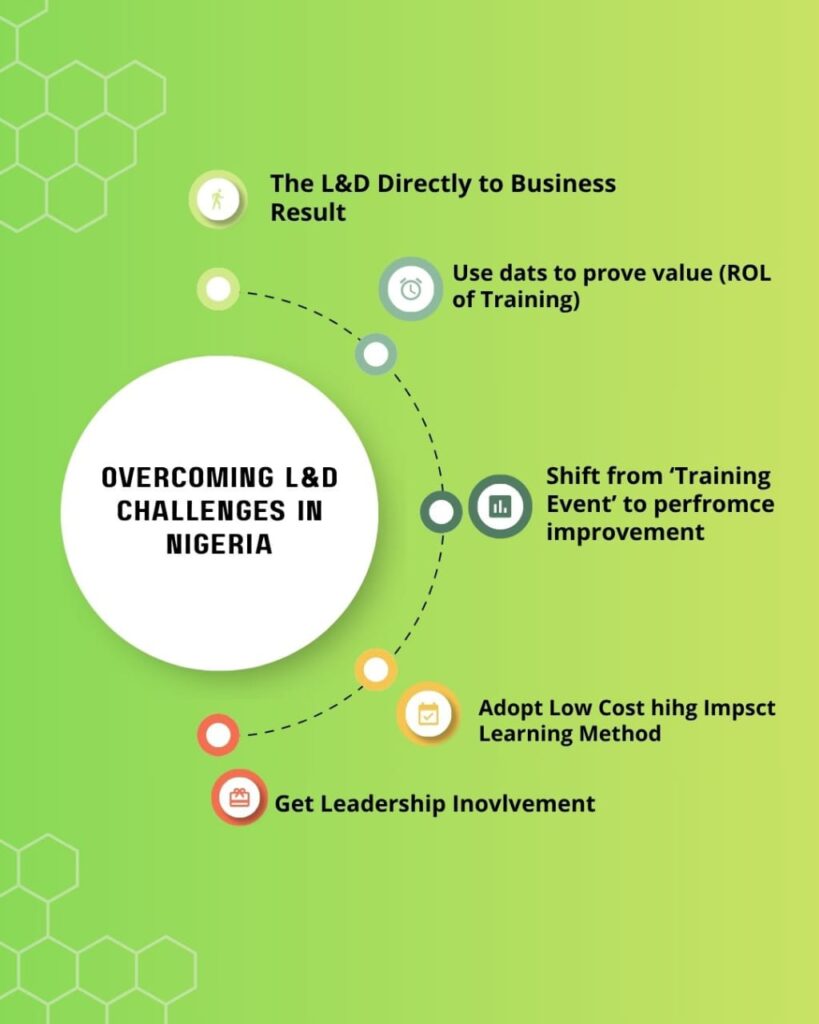
For Nigerian organizations, this shift requires a change in mindset—where training is designed with clear business outcomes in mind and its impact is measured using performance indicators like efficiency, profitability, and employee retention. When this is achieved, L&D becomes a powerful driver of competitive advantage rather than just a support function.
1. Align L&D with Business Objectives
Training should directly impact key outcomes such as:
- Revenue growth
- Productivity improvement
- Customer satisfaction
- Operational efficiency
2. Measure and Demonstrate ROI
Use data to track:
- Pre- and post-training performance
- Cost savings from improved efficiency
- Revenue growth linked to skill development
3. Focus on Performance Improvement, not just training
Shift from delivering training programs to solving business problems, instead of focusing on just running workshops or seminars, L&D should answer:
What performance problem are we solving?
What skill gap is causing it?
This makes L&D problem-focused, not event-focused.
4. Leverage Cost-Effective Learning Methods
Organizations can maximize impact through:
- Micro learning
- Digital platforms
- Internal knowledge sharing
- On-the-job training
5. Secure Leadership Buy-In
Leadership involvement ensures:
- Organizational commitment
- Increased employee participation
- Better application of learned skills
Measuring the Impact of L&D Programs
The transforming L&D into a strategic value driver, impact measurement is essential because it shifts L&D from being viewed as a cost to being recognized as an investment that delivers measurable returns. Without measurement, training remains an activity; with measurement, it becomes a business strategy.
Key Areas of Measurement
- Employee Performance Improvement: Evaluating changes in how employees perform tasks after training.
- Productivity Levels: Measuring increases in output, efficiency, and work quality.
- Skill Application: Assessing how well employees apply new knowledge on the job.
- Business Outcomes: Tracking results such as revenue growth, cost reduction, or improved customer satisfaction.
- Employee Retention: Observing whether training contributes to reduced turnover and higher engagement.
The Business Case for Investing in L&D
The business case for investing in L&D supports transforming L&D into a strategic value driver in organizations by showing that employee development is not a cost, but a growth investment. It demonstrates how L&D enhances productivity, employee performance, and efficiency, leading to measurable business outcomes such as increased revenue, improved service delivery, and reduced employee turnover.
By aligning training with business goals, organizations ensure that L&D directly contributes to competitiveness, innovation, and long-term sustainability—making it a key driver of organizational success rather than a support function.
Conclusion & Expert Insight
The shift from seeing L&D as a cost centre to embracing it as a strategic value driver is essential for the growth of Nigerian organizations. When L&D is intentionally aligned with business objectives, effectively measured, and supported by leadership, it becomes a catalyst for improved performance, innovation, and long-term competitiveness.
The real strength of modern organizations is not in how much they spend on training, but in how strategically they use L&D to drive performance. When learning is tied to business outcomes, it stops being a cost and becomes a powerful engine for sustainable success.